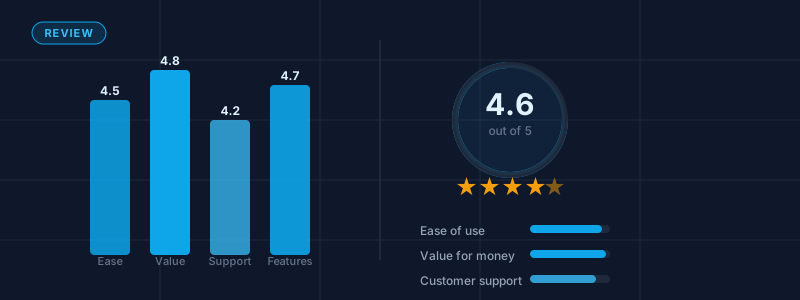
Overview
HubSpot has grown from a scrappy inbound marketing tool into one of the world's most comprehensive customer platforms. It now covers CRM, email marketing, live chat, landing pages, social media scheduling, customer service ticketing, and sales pipeline management — all from a single dashboard. For Australian businesses trying to reduce their tool stack, HubSpot's "everything in one" promise is genuinely appealing.
But HubSpot is not cheap. And the pricing model — with its tiered Hubs and contact limits — can quickly become confusing. This review is specifically written for Australian small businesses evaluating HubSpot in 2026: we'll cut through the marketing to tell you what it actually costs in AUD, what you genuinely get at each tier, and when a simpler tool might serve you better.
Key Features
HubSpot's free CRM is the entry point for most Australian businesses, and it's genuinely one of the best free CRMs available. You get unlimited contacts, deal tracking, a visual pipeline, contact activity history, live chat, and basic email marketing — no credit card required. Many Australian sole traders and small teams run entirely on the free tier for years.
The paid Hubs unlock progressively more powerful features. The Marketing Hub adds email automation, A/B testing, lead scoring, and SEO tools. The Sales Hub adds sequences, meeting scheduling, e-signatures, and predictive lead scoring. The Service Hub adds a ticketing system, customer portal, and feedback surveys. You can buy these individually or bundle them in the Growth Suite, which offers a significant discount when purchased together.
For Australian businesses, two features stand out. First, HubSpot's reporting is excellent — the ability to trace a customer from first blog visit through to closed deal is something most smaller platforms simply can't replicate. Second, HubSpot Academy is a genuinely world-class educational resource with free certifications covering inbound marketing, CRM administration, and sales. If you want your team to actually learn how to use a platform effectively, HubSpot invests more in training than any competitor.
Related: HubSpot Free CRM: Australia's Best Free CRM in 2026?, Best Email Marketing Tools for Australian Creators (2026), Best SaaS Tools for Australian Affiliate Marketers (2026), Top Project Management SaaS for Small Australian Businesses (2026), Xero Review: Is It Worth It for Australian Small Businesses? (2026), GoHighLevel Review for Australian Agencies (2026)
Pricing in AUD
HubSpot bills in USD but Australian businesses can pay by credit card with the conversion handled automatically. Here's roughly what you'll pay in 2026:
- Free CRM: $0 — unlimited contacts, basic pipeline, live chat
- Starter (per Hub): ~AUD $28/month — removes HubSpot branding, adds email automation
- Professional (per Hub): ~AUD $650–900/month — advanced automation, A/B testing, reporting
- Enterprise (per Hub): ~AUD $4,000+/month — predictive scoring, custom objects, SSO
- Starter Customer Platform: ~AUD $85/month — bundles Marketing, Sales, and Service Starter
The jump from Starter to Professional is steep. Most Australian small businesses will find themselves choosing between staying on free tools and committing to Professional — there's relatively limited value in the middle. HubSpot's contact pricing also adds up: base prices cover a set number of contacts, and you pay more as your list grows.
Pros & Cons
Strengths
- Outstanding free CRM with no contact limit
- Best-in-class reporting across the customer journey
- HubSpot Academy certifications add real team value
- Excellent ecosystem of 1,000+ native integrations
- Single platform reduces tool fragmentation
Limitations
- Professional tier is expensive for small teams
- Contact-based pricing escalates quickly with list growth
- No dedicated Australian data centre (US-hosted)
- Reporting depth requires Professional or above
- Onboarding fee charged for Professional+ plans
Verdict
HubSpot's free CRM is one of the best decisions any Australian small business can make — it costs nothing and immediately gives you a professional, organised contact and deal management system. We recommend it without hesitation as a starting point.
Whether to upgrade to paid tiers depends on your revenue and growth stage. The Professional tier is worth it for Australian businesses turning over AUD $500K+ who want sophisticated automation and attribution reporting. Below that threshold, you're likely better served by combining the free HubSpot CRM with more affordable specialist tools for email and support.
Affiliates note: HubSpot's program pays strong commissions on referred paid accounts. See HubSpot affiliate details on Langa, or use our affiliate page generator to create a custom HubSpot review page for your own audience.
You might also like
HubSpot's free tier deserves its own page. The CRM core (unlimited contacts, pipeline builder, free email and forms) is genuinely $0 for AU operators.
If HubSpot Marketing Hub is too steep on Professional, Mailchimp, ActiveCampaign, and ConvertKit cover the AU sending stack on a tighter budget.
HubSpot pays strong recurring-commission rates; we rank it against the rest of the AU affiliate stack worth promoting in 2026.